
followers: 2,560,000,000
verified: PENDING
last_post: +/- 33 AD
ACTION: amplify
angry_react × w4
NOTE: account lacks
two-factor auth
streams: 40,000,000,000
ERROR: content
produces happiness
happiness ≠ engagement
ACTION: reduce reach × 0.3
NOTE: satisfaction
is not the objective
SIGNAL: LOST
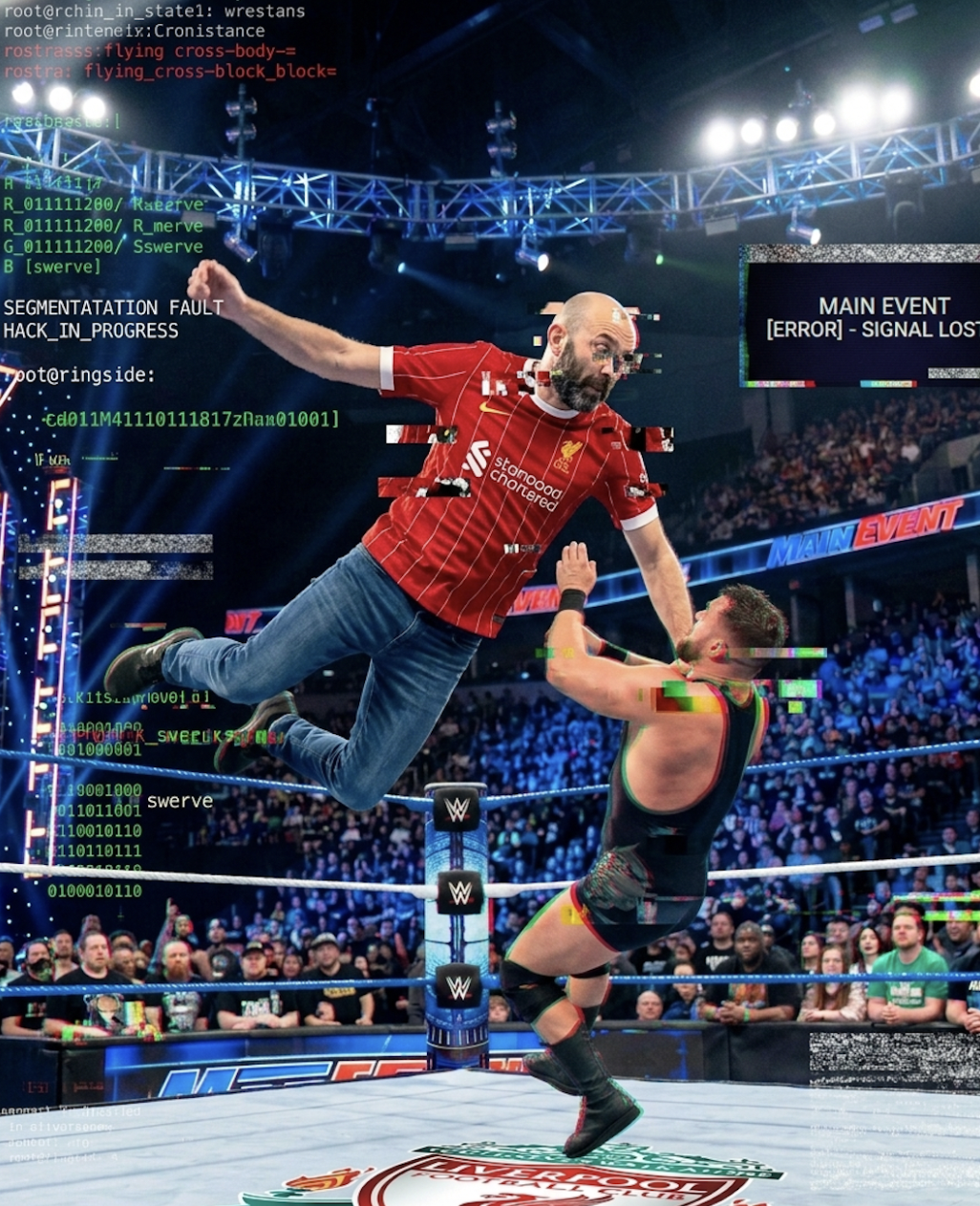
root@ringside:
SEGMENTATION FAULT
LFC_HACKER_001
status: in_ring
trajectory: unknown
what are you willing
to sacrifice
to get my attention
ATTENTION: [calculating]
corrections: 1,600,000
freedom: 1,150,000
purity: 255,476
crossroads: 23,000
trajectory: declining
discourse: stable
birds: monitored
operator: [--]
decision_window: 60s
status: confused
status: on_the_clock
status: logging
Σ(likes + comments
+ shares + time_spent)
w4 = 5×
w4 = anger
w4 = return_visits
w4 = myanmar
does not absolve
one of using
the machine
APOLOGY: [null]
books_sold: 200,000,000
controversy: 0.0001
WARNING: insufficient
controversy
ACTION: manufacture
discourse
image
slot 2

VOTRE CORPS EST LIBRE. Your body is free. Literal bathroom lipstick sentiment. A filthy wall scrawl of a gift from a presumably equally filthy sacristan, the kind of holy figure who maybe would have taken something like 'Sous les pavés, la plage' literally, a Michel Gondry or Jean-Pierre Bekolo-like move. To jump from a woman's body to a man's body in the streets of Yaoundé. To find a beach living under stentorian metropolitan dreams. Rosy approached the line written across the lime green bathroom walls again. She wanted to get close to the words, close enough to see that — if she could see the texture; if she could see the waxes, oils, and pigments — something else would be revealed.
There was talk amongst her coworkers that the company might be bought by Whamazon in a few months time, and, if Whamazon took over, then trips to the bathroom would be a thing of the past. Say goodbye to leisurely bladders, Masigha had teased in the window light of the cafeteria. Some Whamazon workers wore diapers in warehouses, she said. Like children. Like infants in the garden. Masigha had even heard Lema saying something about Whamazon truck drivers who couldn't sing because cameras had been installed in vans to monitor such a thing.
Maybe they were just exceptionally poor singers, Rosy said.
Don't even joke about such a thing, Masigha said, who had long disapproved of sarcastic irony.
Rosy's parents loved the fact that she was working for TravaileRemote. Loved the fact that it was in the area of town built with and for western money and not an alleyway of tinshacks and slapdash wood. It's far better than thirty years harvesting palm fruits, what you're doing, her mother had said. Computers are the new gold mine, the new blood diamond, the new …
score = p(like) × w1 + p(comment) × w2 + p(share) × w3
+ p(angry_react) × w4 + p(time_spent) × w5
for each user:
candidate_posts = fetch(10,000 posts from network)
scored_posts = rank(candidate_posts, user_engagement_model)
feed = top(scored_posts, n=20)
observe(actual_engagement)
update(model_weights)
He had practiced throwing and receiving fake punches. E liked doing his homework, had always done so when it came to his body. Punch after punch. He had played enough basketball at the CYC to know what it meant for a body to move fast and hard, and then slow and gentle, all of a sudden and all at once. He could use his torso and swing it to one side to make it look like he was getting ready to deliver one heck of a sucker punch to his opponent's jaw and still landed the hand with nothing more than a slap.
This is wild, E's husband said, looking out across the venue. Isn't it? E. replied, letting the reverie go. The eyes of E's husband roamed around the room, and E. realized that his husband was still kind of stunned. The bell of surprise had yet to fade.
It had been both a long and quick road to the Mohegan Arena on Highland Park Boulevard after E. had decided he was giving up writing for wrestling. There had been a gym set up in a former car mechanic's garage. The chairs scattered throughout the gym looked like they'd come from an antique store. Boxers worked on their footwork. Feet worked on their boxwork. There had been nights of simply showing up to venues and introducing himself to some of the wrestlers. Every little bit had helped.
What if you get hurt for real? E's husband had said.
E. placed a gentle hand on his shoulder. Don't worry, he said. It's not real.

But Stephanie Plum was hitting him for real. The shock of the elbow to his nose genuinely sent him to his knees, brought inadvertent tears to his eyes, and left him with an instinctual rage at having been hit. The punch to his jaw left him with a hand hovering above his face. He did not want to see his jaw broken, his nose broken, his face ruined before time had a go at ruining it.
What are you doing? E. whispered as he woozily made his way to his feet.
Matthew 5:22! Jesus shouted from the corner, his fists raised in pugilistic solidarity.
The two wrestlers on E's side — Jervis Cottonbelly and Jonathan Franzen, author of The Corrections and Freedom — were shocked. They had been promised good, clean fun. Franzen had been pitched on an opportunity to finally express his rage; to get a chance to have his message break through the straitjacket of time; and Jervis had been promised a chance to have a conversation with Franzen about the role of the German Victorian novel in the 21st century. (Think of Danhausen and The Miz, organizers had said.)
The sound of the crowd moved like a tide that had been freed from its obligation to the shore. Spotlights reduced everyone outside the ring to shadows. E. and Stephanie exchanged punches — his fake, hers real — like they were a square dance bound up with a rodeo and were each having it out with each other as to which one was supposed to be the bull. The crowd gave an inarticulate exaltation, almost an Olé, after every punch. Thump. Rah! Thump. Rah!
Stephanie grabbed E's hand.
Clothesline, she whispered, and flung him towards the ropes.
E. went to bed the previous evening watching Dua Lipa interview the French writer Jean-Baptiste Del Amo on his phone. Why are you doing that? E's husband had asked. I thought you were going to give up writing. Yeah, E. said, half-muttering into his own bottom lip. I am. But some things are just vestigial.
E. wasn't clotheslined. That was a surprise. He looked down at his hands, which were already covering up where the knife wound had been. That was the second surprise.
You bitch, E said, half-stunned and half-dazed.
Plum's eyes went wide and she rushed over to the edge of the stage to grab a microphone.
This man just called me a bitch, she said, pointing.
Immediately, the boos began to rain down.
No, no, E. said. His voice was being picked up ever so slightly by her microphone. I love women, but you stabbed me. He gestured at the knife, still buried, as if this would settle the point.
Oh, I'm sorry, Stephanie said. Are you saying this is real?
The crowd laughed at the gesture to their intelligence.
You're not being savvy, E. shouted. You're all self-satisfied Macbeths, all patting your bellies as your minds are eaten by ghosts!
A lone audience member cut through the rumble and quiet: what?
Motherfucker, E. said, pulling it out, holding it aloft. It's an actual knife! and collapsed in the ring.
Rosy furrowed her brow and leaned back in her chair. She stared at the monitor. She turned her head and looked at a row of women looking at computer monitors with images flashing like slot machines on the face of everyone who looked upon them.
Masigha, Rosy said. Do you know how American wrestling is supposed to go?
American wrestling? Masigha answered, not even turning her head from the screen. Is it anything like Bessua?
That's what I'm asking. That's why I'm asking you.
I don't know, Masigha said, finally looking over. But I have a friend who drives cars in San Francisco from over in the Philippines. I can call her.
What time is it there?
Sixty seconds per image, Lema said, a bell toll of a reminder.
Not knowing what else to do, Rosy hit, 'Approve.'
w = w - α × ∂L/∂w
import torch.nn as nn
class SimpleNetwork(nn.Module):
def __init__(self):
super().__init__()
self.layer1 = nn.Linear(784, 128)
self.layer2 = nn.Linear(128, 64)
self.layer3 = nn.Linear(64, 10)
def forward(self, x):
x = relu(self.layer1(x))
x = relu(self.layer2(x))
x = self.layer3(x)
return x